Burnout Is More Than Just Stress—It’s Your Body Shutting Down

I didn’t realize I was burned out until my body made the decision for me. I kept insisting I was “fine.” I told myself I just needed a couple weeks off, stronger coffee, a different supervisor, maybe a second glass of wine at night to take the edge off. Meanwhile, my brain was dimming like a house with faulty wiring, and my body was throwing up red flags I refused to see.

Burnout doesn’t announce itself. It creeps in quietly. And by the time you notice, you’re already living inside it—or you’re on your couch having a stress-induced stroke, not realizing what’s happening until the next day when half your face won’t move and your left side isn’t responding.

Burnout isn’t just being exhausted or stressed out. It’s a full-body shutdown disguised as “pushing through.” It’s your mind, your nervous system, and your physical health quietly collapsing under demands that were never sustainable.

We like to pretend burnout is a personal failure — like if we’d just been stronger, more organized, more resilient, we could have handled it. But burnout isn’t a lack of grit. It’s a physiological response to chronic stress, unmet needs, toxic systems, and emotional overload. It’s what happens when your life keeps asking you to be superhuman and you keep trying to oblige.

Common Signs of Burnout

  • Exhaustion: physical, emotional, and mental depletion that rest doesn’t fix.
  • Cynicism or Detachment: withdrawing, feeling disconnected from work or people, going through the motions.
  • Reduced Sense of Effectiveness: feeling like nothing you do matters or that you’re failing even when you’re not.
  • Irritability or Emotional Blunting: snapping over small things, or feeling nothing at all.
  • Body Stress Symptoms: headaches, digestive issues, pain flare-ups, brain fog, trouble concentrating.
  • Sleep Disruption: insomnia, oversleeping, or restless sleep.

Burnout shows up in ways that are easy to dismiss at first. Maybe you start waking up already tired, no matter how much you sleep. Maybe everything feels heavier than it should — answering emails, making decisions, showing up, being “on.” Your patience gets thinner. Tasks you used to handle without effort now feel impossible. You might feel numb, irritable, detached, or like you’re watching your life from the outside.

Creativity dries up. Joy feels distant. Your body may start chiming in: headaches, muscle tension, chest tightness, gut issues, insomnia. You keep pushing, because that’s what you do—until your brain and body stop negotiating and start shutting things down.

If this sounds familiar, you’re not imagining it. There’s data to back exactly how this happens.

Chronic stress wears down your mood, weakens your immune system, disrupts digestion, and strains your heart.

A 2020 study found that work stress and burnout feed into each other, but not equally; burnout actually increases work stress more than work stress increases burnout. In other words, once you’re burned out, nearly everything at work feels harder. The small things feel like big things. The doable becomes overwhelming.

Another study showed that even the commute can be a burnout trigger—the longer, more unpredictable, or more draining the commute, the more stress accumulates before you even walk through the door. It’s not just the job; it’s the entire ecosystem around it.

The body is often the first to call out what the mind refuses to see. My wake-up call was an ischemic stroke. I don’t say that for shock value—just to illustrate how far burnout can push you. Before it gets there, you might…

  • Be unable to sustain your usual pace—everything takes more energy than it should.
  • Have trouble falling asleep, staying asleep, or waking up exhausted anyway.
  • Notice your body reacting—headaches, nausea, gut issues, tension you can’t stretch away.
  • Have other physical symptoms show up without a clear medical cause.

How Burnout Changes You (The Part No One Talks About)

Burnout doesn’t just make you tired. It changes who you are while you’re still trying to pretend everything is fine. You start cutting corners on the things that used to matter to you. You stop reaching out. You stop laughing as easily. Your world gets smaller. You become someone who runs on autopilot — doing what needs to be done, exactly how it needs to be done, but without the spark you used to have.

And if you work in a helping profession, you feel guilty about it. You’re supposed to care. You’re supposed to be present. But when you’re burned out, empathy feels expensive. Your emotional bandwidth narrows. You still show up, but the part of you that connects — the part that makes you good at what you do — feels muted. And that loss is its own kind of grief.

Risk Factors for Burnout

Gallup identifies five major factors that significantly increase your risk of burnout:

1. Unfair treatment at work

2. Unmanageable workload

3. Lack of role clarity

4. Lack of communication and support from manager

5. Unreasonable time pressure

Preventing Burnout

Preventing burnout isn’t about quick fixes or productivity hacks. It’s about recognizing your limits and honoring them before your body has to scream. That means setting boundaries you actually keep, not the kind you apologize for. It means learning to say “no” without writing a three-paragraph justification. It means taking breaks before you’re shaking, not after.

It means paying attention to the early signs—the irritability, the brain fog, the losing-your-spark feeling—and treating them as red flags, not personality flaws. And sometimes, prevention looks like stepping back, reevaluating the work you’re doing, and asking whether the life you’re building still fits. Burnout doesn’t happen because you’re weak. It happens because you’ve been strong for too long, without support. The strategy is not to toughen up—it’s to stop carrying everything alone.


Healing Burnout


Healing from burnout isn’t quick, and it isn’t glamorous. In my case, the breaking point was a stroke that hit two days after I was demoted, following my report of unprofessional behavior in management to HR.

It starts with stopping—really stopping—long enough for your nervous system to come down from survival mode. That might mean taking medical leave, switching shifts, asking for help, delegating, or letting some things drop completely. Rest isn’t lazy here; it’s treatment.

Next comes rebuilding capacity: gentle routines, predictable days, moving your body in ways that feel supportive rather than punishing, and slowly reintroducing things that make you feel like yourself again.

You’ll probably have to relearn how to do “nothing” without guilt. You’ll also need to examine the beliefs that drove you past your limits in the first place — the “I have to hold everything together,” or “I can’t disappoint anyone,” or “If I stop, everything falls apart.” Healing burnout means choosing your life, not just enduring it. And yes, it’s possible — even if right now it feels like you’re made of exhaustion.

Practical Strategies for Healing Burnout

Reassess your workload and role.
Healing burnout sometimes requires changing the job, the schedule, or the expectations — not just changing your attitude about them.

Prioritize real rest, not collapse.
Rest on purpose, before you crash. Short, scheduled pauses during the day do more good than occasional total shutdown.

Simplify wherever you can.
Reduce decision fatigue: meal plan, automate bills, declutter your workspace, wear repeat outfits. Less mental load = more recovery.

Set boundaries that are non-negotiable.
Choose one boundary to start with (ex: “I stop working at 6,” or “I don’t check email on days off”) and hold it firmly.

Delegate or ask for help.
Not because you’re failing — but because humans aren’t meant to do everything alone. Even one small shift makes a difference.

Re-establish basic rhythms.
Aim for consistent sleep/wake times, gentle movement (like walks or stretching), and regular meals. Predictability calms the nervous system.

Limit overstimulation.
Noise, screens, constant notifications, and multitasking all drain energy. Turn off what you can. Single-task whenever possible.

Check in with your body.
Notice tension, headaches, stomach issues, shakiness, zoning out. Don’t push through — treat these as signals, not inconveniences.

Reintroduce one thing that brings you joy.
Not a whole hobby. Not a lifestyle overhaul. Just one small spark: reading 10 minutes, music that moves you, stepping outside, journaling.

Conclusion

You deserve a life that doesn’t require your body to break in order to get your attention. Burnout is not a personal failure; it’s a signal. A boundary crossed. A story of overcapacity and overcare colliding. If you’re reading this and recognizing yourself, take it seriously — not with panic, but with clarity.

Your body is asking for relief, not punishment. Your life is asking for space, not endurance. You don’t have to earn rest. You don’t have to prove your worth by suffering. You get to choose a different way forward — slowly, gently, piece by piece. And you’re allowed to start now.

Take a free burnout assessment here.

8 Free Resilience Workbooks

Resilience isn’t about avoiding hardship—it’s about growing through it. Whether you’re navigating personal loss, chronic stress, or just trying to stay afloat in a chaotic world, developing emotional resilience can make all the difference. To support your journey, I’ve compiled a list of free resilience workbooks for teens and adults—resources designed to help you build mental strength, emotional flexibility, and healthier coping skills. These guides are ideal for individuals, therapists, educators, or anyone looking to cultivate a stronger sense of inner calm and grit.

“Life doesn’t get easier or more forgiving, we get stronger and more resilient.”

Steve Maraboli

Please note: These are external resources and are not affiliated with my site. Be sure to review each for suitability, and as always, follow all copyright guidelines when using or sharing materials.

1. Discover the Resilient You, 7 pages


2. Manage Stress Workbook, 20 pages

This workbook was designed by the National Center for Health Promotion and Disease Prevention (NCP) for managing stress more effectively.


3. Mind Matters: Resilience Toolkit, 15 pages

Hard knocks, misfortune and adversity are things all humans have in common. We all are asked to cope with difficult times at some point in our life. Resilience is defined as the ability to adapt well in the face of adversity, trauma, loss or significant stress, bounce back from it and learn from it.


4. Resilience Toolkit, 52 pages

This resource is an initiative of Glasgow CHP South Sector Youth Health Improvement team developed in partnership with The South Strategic Youth Health and Wellbeing Group. This Emotional Resilience Toolkit provides practical guidance in promoting the resilience of young people as part of an integrated health and wellbeing programme. The resource is designed to be used by workers and volunteers working with young people aged 10 and over.


5. Resilience Workbook, 69 pages

This workbook provides a practical and entirely educational approach to improve personal resilience. The material is organized as a series of resilience exercises that support World Health Organization recommendations for suicide prevention. The exercises and the learning methods develop problem solving abilities and bring awareness to the importance of social support by applying positive coping skills to create less stressful outcomes to real life challenges. The materials can be used with all audiences to include organizations, educational settings, and families.


6. The Resiliency Toolkit, 297 pages

The Resiliency Toolkit is a comprehensive, evidence-informed workbook featuring 73 tools and worksheets designed to help people develop the emotional, mental, and behavioural skills needed to overcome life’s challenges. Created by Angela M. Doel, MS, this resource blends therapeutic techniques from CBT, ACT, solution-focused therapy, and positive psychology to support individuals in becoming more resilient, hopeful, and emotionally well.


7. The Resilient Life, 72 pages

8. Understanding & Building Resilience, 9 pages

The simplest way to define resilience is the ability to “bounce back” from life’s difficulties – to adapt well in the face of adversity or significant sources of stress, such as family and relationship issues, major health problems or financial hardships.


“Resilience is not what happens to you. It’s how you react to, respond to, and recover from what happens to you.”

– Jeffrey Gitomer

Supplementary Materials

Disclaimer: The following supplementary materials are intended to be used exclusively in conjunction with corresponding workbooks which must be purchased separately. They are designed to support the content and exercises within the workbooks and are not intended to be a standalone resource. Unauthorized distribution, reproduction, or use of these materials without the accompanying workbook is prohibited. Please respect copyright and intellectual property laws.


For highly-rated resilience guides and workbooks that can be purchased on Amazon, see below:

4.7 stars on Amazon, 1,961 reviews

Publisher’s description on Amazon: NEW YORK TIMES BESTSELLER A masterpiece of warrior wisdom: how to be resilient, how to overcome obstacles not by “positive thinking” or self-esteem, but by positive action. The best-selling author, Navy SEAL, and humanitarian Eric Greitens offers a self-help book unlike any other.
“Eric Greitens provides a brilliant and brave course of action to help navigate life’s roughest waters.”—Admiral Mike Mullen, seventeenth chairman of the Joint Chiefs of Staff
In 2012, Eric Greitens unexpectedly heard from a former SEAL comrade, a brother-in-arms he hadn’t seen in a decade. Zach Walker had been one of the toughest of the tough. But ever since he returned home from war to his young family in a small logging town, he’d been struggling. Without a sense of purpose, plagued by PTSD, and masking his pain with heavy drinking, he needed help.
Zach and Eric started writing and talking nearly every day, as Eric set down his thoughts on what it takes to build resilience in our lives. Eric’s letters — drawing on both his own experience and wisdom from ancient and modern thinkers — are now gathered and edited into this timeless guidebook.
Greitens shows how we can build purpose, confront pain, practice compassion, develop a vocation, find a mentor, create happiness, and much more. Resilience is an inspiring meditation for the warrior in each of us.
“This book is a gift not only to Greitens’s comrades-in-arms, but to readers everywhere.”—Publishers Weekly, starred review


4.6 stars on Amazon, 1,415 reviews

Publisher’s description on Amazon: These days it’s hard to count on the world outside. So it’s vital to grow strengths inside like grit, gratitude, and compassion—the key to resilience, and to lasting well-being in a changing world.
True resilience is much more than enduring terrible conditions. We need resilience every day to raise a family, work at a job, cope with stress, deal with health problems, navigate issues with others, heal from old pain, and simply keep on going. 
With his trademark blend of neuroscience, mindfulness, and positive psychology, New York Times bestselling author Dr. Rick Hanson shows you how to develop twelve vital inner strengths hardwired into your own nervous system. Then no matter what life throws at you, you’ll be able to feel less stressed, pursue opportunities with confidence, and stay calm and centered in the face of adversity. 
This practical guide is full of concrete suggestions, experiential practices, personal examples, and insights into the brain. It includes effective ways to interact with others and to repair and deepen important relationships. 
Warm, encouraging, and down-to-earth, Dr. Hanson’s step-by-step approach is grounded in the science of positive neuroplasticity. He explains how to overcome the brain’s negativity bias, release painful thoughts and feelings, and replace them with self-compassion, self-worth, joy, and inner peace.


4.5 stars, 2,074 reviews

Publisher’s description on Amazon: In Do Hard Things, Steve Magness beautifully and persuasively reimagines our understanding of toughness. This is a must-read for parents and coaches and anyone else looking to prepare for life’s biggest challenges.”—Malcolm Gladwell, author of Outliers and Talking to Strangers and host of the Revisionist History podcast. From beloved performance expert, executive coach, and coauthor of Peak Performance Steve Magness comes a radical rethinking of how we perceive toughness and what it means to achieve our high ambitions in the face of hard things. Toughness has long been held as the key to overcoming a challenge and achieving greatness, whether it is on the sports field, at a boardroom, or at the dining room table. Yet, the prevailing model has promoted a mentality based on fear, false bravado, and hiding any sign of weakness. In other words, the old model of toughness has failed us. Steve Magness, a performance scientist who coaches Olympic athletes, rebuilds our broken model of resilience with one grounded in the latest science and psychology. In Do Hard Things, Magness teaches us how we can work with our body – how experiencing discomfort, leaning in, paying attention, and creating space to take thoughtful action can be the true indications of cultivating inner strength. He offers four core pillars to cultivate such resilience: 

  • Pillar 1: Ditch the Façade, Embrace Reality
  • Pillar 2: Listen to Your Body
  • Pillar 3: Respond, Instead of React 
  • Pillar 4: Transcend Discomfort   

Smart and wise all at once, Magness flips the script on what it means to be resilient. Drawing from mindfulness, military case studies, sports psychology, neuroscience, psychology, and philosophy, he provides a roadmap for navigating life’s challenges and achieving high performance that makes us happier, more successful, and, ultimately, better people.


Additional Therapist-Recommended Resources for Resilience

6 Powerful Non-Traditional Therapy Approaches for Healing

When most people think of therapy, they picture sitting in an office talking to a psychotherapist. But healing doesn’t always look like a conversation across a couch. While traditional talk therapy is incredibly effective, many people also find relief and growth through non-traditional therapy and alternative approaches.

If you’ve ever felt like talk therapy wasn’t quite enough—or you’re simply curious about what else is out there—this post will walk you through several non-traditional therapy alternatives that support mental health and overall well-being.

Digital Non-Traditional Therapy Alternatives

Sometimes, the biggest barrier is access. That’s where digital platforms can help as non-traditional therapy alternatives.

  • Headway connects you with therapists who take your insurance—removing one of the biggest hurdles people face.
  • BetterHelp and Talkspace offer flexible, online therapy that fits into busy schedules.
  • Online-Therapy.com combines live sessions with structured worksheets, making it a more hands-on, skill-based option.

These platforms expand therapy beyond a once-a-week session and can be more accessible for people who want affordable, convenient care.

Mind-Body Practices

Our bodies hold stress and trauma, so healing isn’t always about words—it’s also about movement and stillness.

  • Calm or Headspace can introduce daily mindfulness practices to reduce stress.
  • Insight Timer offers free meditations as well as paid programs with expert teachers.
  • Yoga platforms like Alo Moves or Glo help people reconnect with their bodies through breath and movement.

These practices support nervous system regulation, which is often the foundation for deeper healing.

Creative & Expressive Therapies

For some, the path to healing is artistic expression.

Self-expression can unlock emotions that are hard to articulate, making creativity a powerful therapeutic tool.

Lifestyle & Holistic Wellness

Mental health is deeply tied to sleep, nutrition, and daily habits. Apps and programs designed for whole-person wellness can provide the missing puzzle piece.

  • BetterSleep focuses on improving rest, which directly impacts mood.
  • Noom Mood uses CBT-based techniques to manage stress and anxiety.
  • Devices like Muse or Apollo Neuro use biofeedback to help retrain your brain and body’s response to stress.

Free Non-Traditional Therapy Alternatives: Evidence-Based Self-Help & Mental Health Websites

These are also great resources, including this site, for evidence-based workbooks, worksheets, and psychoeducation, often free or low-cost.

American Psychological Association (APA) HELP CENTER – USA Articles and guides on stress, resilience, relationships, and wellness.

Anxiety & Depression Association of America (ADAA) – USA Evidence-based resources, online peer support groups, and self-help tools for anxiety, depression, and related conditions.

Anxiety Canada Self-help strategies, My Anxiety Plan (MAP), and youth/parent resources.

Black Dog Institute – Australia Offers online programs, mood tracking, self-tests, and resources for depression, bipolar, and suicide prevention.

Centre for Addiction and Mental Health (CAMH) – Canada Self-help guides, fact sheets, and coping strategies for addiction and mental illness.

Centre for Clinical Interventions (CCI) – Australia Free, research-based modules and worksheets for depression, anxiety, self-esteem, perfectionism, and more.

The Jed Foundation (JED) – USA Focused on young adult mental health and suicide prevention; has toolkits for resilience and coping.

Mental Health America (MHA) – USA Free mental health screening tools, information, and self-help resources.

Mindful.org – USA Practical (free) resources for mindfulness, meditation, and stress reduction.

MindSpot Clinic – Australia Free online and phone-based assessment and treatment courses for Australians, with downloadable tools.

National Alliance on Mental Illness (NAMI) – USA Education, community programs, helplines, and online guides for living with mental illness.

NHS Every Mind Matters – UK Free resources, self-care plans, and guides for stress, sleep, and mental wellbeing.

Psychotherapy.net (Free Resources Section) – USA Offers therapist articles, videos, and some free resources (though much is paid).

ReachOut – Australia Youth-focused mental health support, self-help tips, and community forums.

The Trevor Project – USA Crisis intervention and self-help resources specifically for LGBTQ+ youth, plus a supportive online community.

Verywell Mind -USA Accessible articles on psychology, wellness, and coping.

Veterans Crisis Line / VA Mental Health Resources – USA Self-help apps, mindfulness tools, and PTSD resources tailored for veterans and military families.

Specialized Supports

Some approaches may not be mainstream (yet) but are gaining traction:

  • Ketamine-assisted therapy (in approved clinics) shows promise for treatment-resistant depression.
  • Neurofeedback and biofeedback offer cutting-edge ways to change brain patterns.
  • Hypnotherapy platforms (like Grace Space) guide users into deep relaxation and change work.

While these approaches aren’t for everyone, they highlight just how many avenues there are beyond talk therapy.

Final Thoughts

Healing isn’t one-size-fits-all. For some, traditional therapy is enough. For others, combining it with mindfulness, creative practices, holistic wellness tools, or other non-traditional therapy approaches makes all the difference.

If talk therapy hasn’t clicked for you—or if you’re looking to enhance your current treatment—consider trying one of these non-traditional therapy options. Sometimes the most powerful healing happens in unexpected ways.


Disclaimer: A few of the links on this page are affiliate links. This means I may earn a small commission—at no extra cost to you—if you choose to make a purchase or sign up through them. These funds go directly toward keeping this site up and running. Please note that I do not specifically endorse any product, service, or organization listed here. The links are provided only as potential resources that may be helpful for your mental health and wellness journey.


A Meaning of Life: Chasing an Impossible Dream of Wellbeing

Guest Post: Introducing a New Resource for Wellness

When we started A Meaning of Life (AMoL), the idea felt at once impossible and completely sane. Impossible because of its scope: to understand human wellbeing in its depth, nuance, and complexity. Sane because—really—what could be more practical than trying to understand what makes life worth living, and then sharing that understanding so others might put that wisdom into practice?

This project began with Randall, our founder, who broke his neck as a teenager, becoming quadriplegic. On the edge of death, Randall chose life—not just to continue living, but to live it fully and to share what he could about how to do so with others.

Decades later—after becoming a PhD psychologist, father, and living a life of many twists and turns—there was no silver bullet. The scientific insights were scattered, the practical applications were fragmented, and the guidance was often oversimplified. Out of that gap came a dream: to create a resource that could bring clarity, evidence, and practical insights together as one.

That dream became A Meaning of Life—a nonprofit and ever-growing library of practical-yet-science-based wisdom for a well-lived life. Today, our website hosts nearly a thousand pages of resources, organized so that it’s personal to you, and you can explore the factors that shape wellbeing in a way that is both grounded in research and deeply human.

Mapping the Web of Wellbeing

At the heart of our project are a handful of helpful mental models: each one takes a different angle of approach to map out the complex, interconnected elements that contribute to a flourishing life. There is the Happiness section, which clarifies the broken concept of wellbeing through both complex and simple lenses—complex like accounting for the inherent tangles in the web of researching wellbeing and providing an overview of Positive Psychology’s leading models, and simple like offering wellbeing in four basic elements: Pleasure, Flow & Engagement, Perspective, and Meaning in Life (the fourth and most important element).

And there are the four Cornerstones of Meaning, each cornerstone itself being a collection of factors that play a role in wellbeing. For most factors of wellbeing (there are 50 identified across the site), readers find detailed infographics, exercises, and curated web resources to guide their journey of learning wellbeing as a skill that can be practiced.

Some of the factors of wellbeing are well-known to most, like Gratitude, Friendship, and Curiosity. Others are easily overlooked, like Happiness as a Hindrance, Listening, and Clean Communication.

Each section of the site explores one of these factors in depth. For example, our Purpose section doesn’t just define the concept; it presents empirical research, practical exercises, and pathways to integrate it into daily life, making your dream life more life-like. It even has a deep-dive workbook for transforming one’s life into one that is rich with purpose.

Our goal isn’t to reduce wellbeing to a single formula, but to show its complexity—and to empower people to explore it in a way that resonates with their own lives.

From Theory to Practice: The Assessment Center

One of the resources we’re most excited about is our Assessment Center. This is where theory meets practice. Visitors can take evidence-based psychological assessments to measure every one of those 50+ factors of wellbeing, identifying which ones are strengths and which are growth zones. This is an incredible tool in its own right, and when paired with the content on AMoL, it can guide people towards what areas of life to study to get the biggest results on their wellbeing.

The assessments are more than just self-discovery, too. The data (always anonymized) has the potential to fuel research, giving psychologists and social scientists valuable insight into what well-being looks like across diverse populations. In other words, every visitor who takes an assessment isn’t just learning about themselves—they’re helping build a collective picture of human flourishing. And we’re committed to making the data free and open to researching… we are a 501c3 non-profit, and we stand by that intent.

We’re especially hopeful about the long-term research potential. Imagine being able to see, at scale, how gratitude impacts resilience, or how value alignment predicts life satisfaction. The Assessment Center opens the door to that kind of knowledge.

Visual Models for a Complex World

We know that wellbeing can feel abstract, so we’ve invested in creating visual models and infographics to make the science more accessible.

For example, our Crisis of Meaning infographic addresses the modern crisis that many people can feel, but few people have considered in detail.

Our visuals, fridge sheets, and printable exercises aren’t just decorative—they’re teaching tools. They’re designed to spark insight, conversation, and reflection, helping people see the bigger picture while also noticing the threads most relevant to their own lives.

Why We Believe This Matters

In a world overflowing with quick-fix self-help advice, our approach might seem unusual. We don’t promise instant happiness or one-size-fits-all answers. Instead, we embrace complexity. We honor nuance. We believe that cultivating a good life is a lifelong practice, grounded in science but enriched by story, art, and humanity.

And we believe this work matters because the stakes are high. Rates of anxiety, depression, and loneliness are climbing. Many people feel disconnected—from others, from purpose, from themselves. In that context, our mission to explore and share the building blocks of wellbeing isn’t just an intellectual exercise. It’s an act of care.

Looking Ahead

We know our dream is ambitious. Sometimes it feels daunting to be building something so wide-reaching as a small nonprofit. But when we hear from people who found comfort in our pages, it reminds us why this work is worth it.

Our hope is that A Meaning of Life can serve as both a mirror and a guide: a mirror that helps people see their own strengths and challenges more clearly, and a guide that points toward practices and perspectives that support flourishing.

An Invitation

If our mission resonates with you, we invite you to explore A Meaning of Life for yourself. Browse our pages. Try out a few assessments in the Assessment Center. Share our resources with a client, a student, a friend, or a family member.

And most importantly, reflect on what you find. Because at the end of the day, the dream we’re chasing isn’t just about knowledge—it’s about transformation. It’s about helping people cultivate lives of greater meaning, connection, and joy. And we’re all on the journey toward that dream together.


Small Habits, Big Shifts: Doctor-Backed Micro-Changes for Better Health

We often think lasting health change requires a big lifestyle overhaul—strict routines, bold resolutions, or a sudden surge of motivation. But in reality, meaningful improvement usually starts with something much smaller: small habits-consistent, doable habits that fit easily into your day.

As a practicing doctor, I’ve seen this firsthand. Many of my patients assume they need to transform their lives to feel better. But time and again, it’s the tiniest daily actions—the small habits that require no special tools and only a few minutes—that lead to the most reliable results. These “micro-habits” are deceptively powerful. They reduce stress, improve sleep, and slowly nudge the body and mind toward resilience.

Let’s explore a few of these low-effort, high-impact habits—along with the science that explains why they work.

Breathing for Calm: One Minute Can Change Your Day

Modern life keeps our nervous systems revved up. From tight deadlines to nonstop notifications, it’s easy to get stuck in a constant low-grade “fight-or-flight” mode. But your body also has a built-in brake: the parasympathetic nervous system, which helps you relax and recover.

A simple breathing pattern can help you access that state. Try this small habit: inhale for four seconds, hold for six, and exhale slowly for eight. Just one minute a day. Research shows that slow, controlled breathing lowers heart rate, reduces blood pressure, and activates the vagus nerve—a key pathway for relaxation and stress recovery.

This one-minute breathing routine is easy to anchor to your day. Try it in the morning before coffee, during a break at work, or while waiting at a red light. Over time, it trains your body to downshift more easily from stress, which can lead to better sleep, sharper focus, and fewer physical symptoms like headaches or muscle tension.

Posture Check-Ins: A Small Habit with Big Effects

We don’t often think of posture as a health issue, but how we sit and stand influences far more than appearance. Slouching restricts breathing, tenses muscles, and can subtly impact mood and alertness. Over time, poor posture can lead to back pain, fatigue, and shallow breathing.

That’s why a simple one-minute posture reset—once or twice a day—can go a long way. Stand or sit tall. Relax your shoulders. Breathe in deeply and gently tuck your chin. It’s not about perfection. It’s about awareness.

Interestingly, posture doesn’t just affect the body—it may also influence the mind. Research suggests that upright posture is associated with more positive emotions and reduced symptoms of depression, while slouched posture can increase self-focus and negative affect.

This small habit will help you reconnect to your body and move through your day with more intention. And as posture improves, many people report feeling more energetic and emotionally grounded.

Expert-recommended posture improvement tools include Upright Go, Prana Wearable (posture and breathing), or the Samsonite Ergonomic Lumbar Pillow (or other quality lumbar pillow).

A Single Food Swap Can Start a Healthier Pattern

When it comes to nutrition, many people get overwhelmed by rules and restrictions. But you don’t need a meal plan or a supplement stack to make meaningful changes. Start with one daily swap, just one small habit. Choose water instead of soda. Add a handful of vegetables to lunch. Pick whole grains over refined ones.

These choices may not seem like much on their own—but they build momentum. They reduce blood sugar spikes, improve digestion, and gradually shift your taste preferences. Perhaps even more importantly, they reinforce a powerful message: I’m someone who takes care of my body.

You don’t have to overhaul your diet to be “healthy.” You just have to keep choosing what supports you, one bite at a time.

Gratitude as a Mental Health Tool & Powerful Small Habit

You’ve probably heard that gratitude is good for you—but the real power lies in how easy it is to practice. Before bed, pause and notice one thing that went well today. A kind word from a friend. A meal you enjoyed. A quiet moment.

That’s it. No journal, no timer, no need for perfect phrasing. Just a brief mental note of what brought you comfort or joy.

There’s strong research behind the benefits of gratitude. People who practice it regularly report lower stress and fewer symptoms of depression. Some studies also suggest a link to better sleep. In fact, gratitude has been shown to trigger positive neural activity in the brain and help regulate the emotional centers that influence anxiety and mood.

You don’t have to “feel grateful” all the time. But building this 30-second small habit can help train your brain to notice what’s going right, even during tough times.

Movement Stacking: Small Habits for Exercise That Hide in Plain Sight

If you’re too busy for a workout, try pairing light movement with something you already do—like brushing your teeth. While standing at the sink, do a few calf raises. March in place. Try some gentle squats or heel-to-toe balances.

It might feel silly at first, but two minutes of movement, twice a day, adds up. It improves circulation, strengthens stabilizing muscles, and reminds your body that it was built to move.

From a doctor’s perspective, this kind of “habit stacking” is incredibly effective. It reduces friction—there’s no need to carve out gym time or change clothes—and it turns physical activity into a normal part of your daily rhythm. Over time, small bursts of movement have been linked to improvements in insulin sensitivity, cardiovascular fitness, and musculoskeletal strength—even in people with limited time. While more research is needed on their long-term cognitive effects, incorporating movement into daily routines remains a practical and evidence-supported way to support whole-body health.

Why These Small Habits Stick (Even When Life Gets Messy)

So what makes these small habits so powerful?

First, they’re easy. They don’t require a major time commitment or a change in identity. You don’t need to become “a fitness person” or “someone who meditates.” You just need to breathe for a minute, stand a little taller, or choose an apple instead of chips.

Second, they create positive feedback loops. When your body feels calmer, or your digestion improves, or you sleep a bit better—you’re more likely to stick with the habit. And when habits are consistent, they start to shift your baseline experience of health.

Finally, these practices support multiple body systems at once. Breathing regulates your nervous system. Posture supports your musculoskeletal and respiratory health. Nutrition feeds your gut and immune system. Gratitude strengthens your emotional resilience. Movement improves metabolism and mobility.

From a medical standpoint, these small habits also support key systems: the autonomic nervous system (for stress), the musculoskeletal system (for posture and movement), metabolic and digestive function (through dietary shifts), and the brain (via gratitude and emotional regulation). That’s a lot of benefit for a few minutes of effort.

Final Thoughts on Small Habits

Health isn’t something we flip on with willpower. It’s something we build—through the quiet, repeatable moments we often overlook. The breath before a meeting. The snack you reach for. The way you sit at your desk. These are the places where health is shaped—not in grand gestures, but in small, meaningful shifts.

So if you’re feeling stuck or overwhelmed, start tiny. Start now. A minute of calm. A better snack. A deeper breath.

Because sometimes the smallest habits make the biggest difference.

About the Author

Dr. Antti Rintanen is a licensed medical doctor and the founder of The Internet Doctor, a platform dedicated to translating complex health science into practical guidance. His focus includes musculoskeletal health, postural alignment, and long-term wellness strategies.


References

Jerath R., Edry J. W., Barnes V.A., Jerath V. (2006). Physiology of long pranayamic breathing: Neural respiratory elements may provide a mechanism that explains how slow deep breathing shifts the autonomic nervous system. Med Hypotheses; 67(3):566-571.https://pubmed.ncbi.nlm.nih.gov/

Katz S., Arish N., Rokach A., et al. (2018). The effect of body position on pulmonary function: A systematic review. BMC Pulm Med; 18(1):159. doi:10.1186/s12890-018-0723-4. https://pubmed.ncbi.nlm.nih.gov/

Schwingshackl L., & Hoffmann G. (2013). Long-term effects of low glycemic index/load vs high glycemic index/load diets on parameters of obesity and obesity-associated risks: A systematic review and meta-analysis. Nutr Metab Cardiovasc Dis.;23(8):699-https://pubmed.ncbi.nlm.nih.gov/

Wood A.M., Froh J.J., & Geraghty A.W.A.(2010). Gratitude and well-being: A review and theoretical integration. Clin Psychol Rev;30(7):890-905.
https://pubmed.ncbi.nlm.nih.gov/

Dempsey P. C., Larsen R. N., Sethi P., et al.(2016). Benefits for Type 2 diabetes of interrupting prolonged sitting with brief bouts of light walking or simple resistance activities Diabetes Care; 39(6):964–972. https://pubmed.ncbi.nlm.nih.gov/

Emmons R .A. , & McCullough, M.E. (2003). Counting blessings versus burdens: An experimental investigation of gratitude and subjective well-being in daily life. J Pers Soc Psychol;84(2):377–389. https://pubmed.ncbi.nlm.nih.gov/

Wilkes C., Kydd R. R., Sagar M., & Broadbent E. (2017). Upright posture improves affect and fatigue in people with depressive symptoms. J Behav Ther Exp Psychiatry;54:143–149. https://pubmed.ncbi.nlm.nih.gov/

Boost Your Counseling Skills with Guiding with Purpose: COMING SOON!

Guiding with Purpose: A Self-Discovery Workbook for Counselors is on its way, and it’s full of helpful tools to make therapists feel stronger, more skilled, and more connected to
their work.

guiding with purpose jewell

Great news for therapists and counselors! A new book is coming soon that will help mental health professionals learn, grow, and feel more confident in their work. Guiding with Purpose: A Self-Discovery Workbook for Counselors by Cassie Jewell, M.Ed., LPC, LSATP, is on its way, and it’s full of helpful tools to make therapists feel stronger, more skilled, and more connected to their work.

This workbook is for anyone working in mental health—whether you’re a student just starting out, a new therapist finding your way, or an experienced supervisor looking for fresh ideas for your students or residents and ways to reflect on your journey.

What Is This Book About?


Guiding with Purpose is not a regular textbook. It’s a hands-on workbook with simple exercises, questions, and activities that help therapists think, learn, and grow.


It will help therapists:

  • Build stronger relationships with clients
  • Improve counseling skills and techniques
  • Feel more confident in their work
  • Stop doubting themselves and overcome imposter syndrome
  • Avoid burnout and stress
  • Make better decisions in tough situations
  • Take care of their own mental health

Therapists spend their time helping others, but this book is here to help them. It gives professionals a chance to reflect, learn, and take care of themselves so they can continue doing their important work.

Who Is This Book For?

This soon-to-be-released workbook is perfect for:

  • Counseling students and new therapists
  • Experienced counselors looking for inspiration
  • Social workers, psychologists, and anyone in mental health
  • Clinical supervisors and teams in training
  • Anyone in the helping professions who wants to feel stronger and more confident

If you work in mental health or are studying to become a therapist, Guiding with Purpose will be a must-have book for your journey.

Why This Workbook Matters

Being a therapist is rewarding; it is also challenging. Many therapists feel tired, unsure, or stressed at some point in their careers. This workbook helps professionals pause, reflect, and grow, making sure they stay motivated and connected to their work.


Many counselors doubt themselves or feel like they don’t know enough. This book helps them see their strengths, build confidence, and find joy in their work again.


It’s not just about learning—it’s about feeling stronger, more balanced, and more prepared for the work therapists do every day.

About the Author

Cassie Jewell, M.Ed., LPC, LSATP, is a licensed therapist, substance abuse treatment practitioner, and clinical supervisor. She is also the creator of Mind Remake Project, a website that shares free mental health resources.

With years of experience in counseling, Cassie knows what it’s like to work in this field—the challenges, the doubts, and the joys. She has also written workbooks on grief and helping people heal after loss. Now, with Guiding with Purpose, she wants to help therapists reflect, learn, and
keep growing.


When Will the Book Be Available?

The release date will be announced soon! Guiding with Purpose will be available in print and digital formats, making it easy for therapists to use.
For updates and details, visit: https://www.mindremakeproject.org or email CassieJewellLPC@gmail.com.

The digital supplementary materials (discussion questions, quizzes, card decks and more can be downloaded/printed for free below, and utilized for educational, self-help, and therapeutic purposes. (Click the hyperlink after the preview to start download.)

Guiding with Purpose: A Self-Discovery Workbook for Counselors

Get Ready to Grow and Learn!

Therapists do amazing work, but they also need time to pause, reflect, and care for themselves. Guiding with Purpose is coming soon to help professionals stay motivated, confident, and balanced in their careers.


If you are a therapist, counselor, social worker, or student, this workbook is for you! Get ready to learn more about yourself, improve your skills, and feel stronger in your work.


Stay tuned! The book is coming soon!

Free Grief Booklet for Inmates

This free grief booklet serves as a guide for those struggling with grief and loss while incarcerated.

Free Grief Booklet: Loss Within the Walls

Loss Within the Walls: Coping with Grief While Incarcerated is a free grief booklet created especially for inmates who are struggling with grief and loss.

“Grief is like the ocean; it comes on waves ebbing and flowing. Sometimes the water is calm, and sometimes it is overwhelming. All we can do is learn to swim.”

— Vicki Harrison

Grief can be especially difficult in a correctional setting where access to support is limited, and emotions can feel heightened.

This free grief booklet aims to guide individuals who are incarcerated through understanding their grief, expressing their feelings, and finding healthy ways to cope in a correctional setting.

Please note that this free grief booklet is meant to be a two-fold booklet. To print two-fold, use the ‘booklet’ setting in Foxit PDF Editor when printing. Otherwise, print to scale (one page per sheet).


This free grief booklet may be reproduced and distributed for personal, therapeutic, and/or educational purposes. Please link to Mind Remake Project when sharing electronic copies.

For a full workbook on grief, created for anyone who is experiencing loss (also free to download), see Free Grief Workbook PDF – mind remake project. For quotes on grief, scroll to the bottom for a printable PDF.

For more grief resources from Mind Remake Project, see 3 Powerful TED Talks on Grief and Grief & Loss: A Comprehensive Resource Guide.

For a free pamphlet for inmates experiencing grief, see When Death Enters Your Life: A Grief Pamphlet | Office of Justice Programs.

For help with prolonged grief disorder, visit the Center for Prolonged Grief.


50 Unique Gifts for Therapists in 2023

This is a list of 50 fun, clever, and unique gifts for therapists, counselors, social workers, and other dedicated mental health workers in 2023.

The role of a therapist is a demanding one, requiring empathy, patience, and a deep understanding of human behavior. While showing appreciation for a counselor’s dedication is always a thoughtful gesture, finding the perfect gift can be a challenge.

This post provides ideas for gifts for therapists and is the third installment of a series I publish annually. (For additional gift ideas from previous years, see 50 Unique Gift Ideas for Therapists in 2022 and 50 Unique Gift Ideas for Therapists.)

The gifts for therapists featured in this post are inspired by items that I, as a counselor, find useful and meaningful, along with unique products that address the needs and wishes I see in other mental health workers.


Similar to last year, many of the products featured here can be purchased on Amazon. What’s new and different this year is that I’ve discovered Temu (thank you, TikTok!), an online marketplace that sells “affordable, quality products from millions of sellers, manufacturers, and brands around the world.”

While Temu products are generally cheaper than goods from Amazon, the quality factor is hit-or-miss. The Temu gifts for therapists listed in this post meet my standards for quality, but it’s important to note there’s no guarantee they’ll come from the same manufacturer.

Also, I’ve included unique gifts that can only be found on Uncommon Goods, an independently-owned business that sells one-of-a-kind goods from artists all over the world. I support the company’s “force for good” business model; Uncommon Goods is environmentally conscientious, gives back to the community, and prioritizes employee wellbeing.


Here is the highly anticipated 2023 list of 50 fun and unique gifts for therapists and other mental health professionals:

50 Unique Gifts for Therapists in 2023

Jump to a section:

Disclaimer: The Amazon and Temu links below are affiliate links; I earn a small commission on qualifying purchases.

Gifts for Therapists Under $10

1. Cleaning Gel

This cleaning gel is an essential tool for any therapist, providing a quick and easy way to maintain a clean and hygienic workspace. Its unique formula effectively removes dust, crumbs, and other debris from keyboards, ensuring that they remain functional for typing up notes and reports.

2. Coffee Mug Warmer

If you’re anything like me, you know the struggle of reaching for your coffee only to find it lukewarm. This beverage warming device is the solution to microwaving the same cup of coffee again and again. With this mug warmer, your beverage stays at the perfect temperature, making it a great gift for the coffee- or tea-loving counselor in your life.

3. Coping Skills Makeup Bag

This adorable and colorful coping skills makeup bag doubles as a pencil case, making it a pretty and practical accessory for counselors.

4. Feelings Wheel Pin

This compact color-coded feelings wheel displays a spectrum of emotions and is equipped with a tiny spinning arrow. The six main categories of feelings – Calm, Strong, Happy, Mad, Sad, and Fear – are further divided into subcategories for identifying more precise emotions. The interactive wheel can be pinned to a bulletin board and used as a visual tool to help clients identify, verbalize, and explore their feelings in therapy sessions.

5. ‘I’ll Be There for You’ Sticky Notes

This is the one where the Friends-fan counselor gets an awesome Friends-themed gift!

6. Little Box of Badass: Embrace Your Awesomeness with Style

In her refreshingly blunt You Are a Badass®, Jen Sincero served up candid and inspiring stories, sage advice, and the occasional swear word, all with the goal of helping readers reverse self-sabotaging behaviors and create a life of love. This little kit is perfect for the badass counselor in your life (as well as a fun tool for their clients!)

7. Phrenology Cat: Read Your Cat’s Mind!

Do you know a cat-loving counselor who needs this?

8. Phrenology Dog: Read Your Dog’s Mind!

No? What about a dog-loving therapist?

9. Therapist Key Chain

Not only is this keyring the thriftiest of featured gifts for therapists, it’s a charming and thoughtful token that serves as a tangible expression of appreciation, making it an ideal gift for any therapist or guidance counselor. Its meaningful message will remind them of the significance of their work and the positive impact they have on the lives of others.

Books & Educational Gifts for Therapists

10. The Adult Psychotherapy Progress Notes Planner

“Documentation dread” is real, and it’s something we as therapists can all relate to. This fantastic planner helps ease that dread by enabling practitioners to quickly and easily create progress notes. (And the less time we spend documenting, the more time we have for what really matters – our clients!)

11. DSM-5-TR Overview: A QuickStudy Laminated Reference Guide

This handy DSM-5-TR reference guide is a top seller on Amazon for its practicality and usefulness. It serves as an invaluable tool for mental health professionals, providing quick access to diagnostic criteria and essential information for accurate and informed assessment. This convenient guide is a must-have for any therapist.

12. The Good Life: Lessons from the World’s Longest Scientific Study of Happiness

What makes a life fulfilling and meaningful? The simple but surprising answer is: relationships. The invaluable insights in this book emerge from the revealing personal stories of hundreds of participants in a Harvard research study as they were followed year after year for their entire adult lives, and this wisdom was bolstered by research findings from many other studies.

13. NCMHCE Exam Prep 2024-2025: NCMHCE Study Material & Practice Questions for the National Mental Health Counseling Exam

These flash cards were developed by Test Prep Books for test takers trying to achieve a passing score on the NCMHCE exam. This is another practical and useful gift for the recently graduated counselor who is studying for the NCMHCE.

14. Seven & a Half Lessons About the Brain

Have you ever wondered why you have a brain? Let renowned neuroscientist Lisa Feldman Barrett demystify that big gray blob between your ears. In seven short essays (plus a bite-size story about how brains evolved), this slim, entertaining, and accessible collection reveals mind-expanding lessons from the front lines of neuroscience research.

Novelty Gifts for Therapists

15. ‘But Did You Document It?’ Wooden block Sign

This fun gift attests to “documentation dread” (refer to #10). The rustic wooden block is made from high-quality materials and will look great as a shelf-piece in any office.

16. ‘The Doctor Is In’ Pin

This playful Peanuts ‘Psychiatric Help’ brooch is cute and cheap!

17. F-Bomb Paperweight

Did you know that swearing is good for your mental wellbeing? This paperweight is the perfect gift for the therapist who loves to swear.

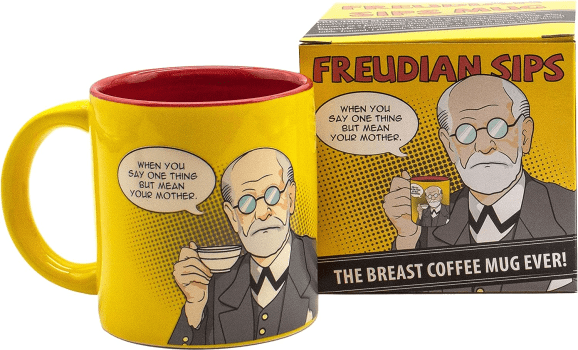
18. Freudian Sips Coffee Mug

This clever mug features Freud (i.e., the “Father of Psychology”) sipping from a cup with a speech bubble reading, “When you say one thing but mean your mother.” The mug comes in a colorful box perfect for gift-giving.

19. Fun Face Stress Ball

Not only does this squishy face stress ball relieve stress, it’s scented too!

20. Mini Himalayan Mood Lamp

This 2-1/4-inch Himalayan mood lamp rotates through a full spectrum of colors, each associated with a different mood or emotion to create feelings of tranquility and peace in any working or living space.

21. NIRMAN Handmade Wooden Nose Shaped Eyeglass Holder with Mustache

This whimsical spectacle holder is highly rated on Amazon for its charm and quirky design. Handcrafted with durable, lightweight materials, it’s the perfect desk accessory for any therapist who wears glasses; their spectacles will always be within reach, the frustration of misplacing them eliminated.

22. Party Freud: A Comical Group Therapy Game

Sigmund Freud once said, “Being entirely honest with oneself is a good exercise.” What about being honest with everyone else? In this lighthearted game of analysis, players score points by giving the best responses and advice.

23. Pavlov’s Cat T-Shirt

Unlike Pavlov’s dog, Pavlov’s cat is no drooling fool for a bell. He awaits the sound of the can opener! This is the perfect gift for the cat-loving counselor in your life.

24. Mini Zen Garden Litter Box

And here’s yet another cat-themed gift…

25. Work-from-Home Survival Kit

The Work-from-Home Survival Kit is a fun and clever gift is for the private practice counselor who works remotely. Of the nine items included, a few are functional (ear plugs, webcam cover), others are just-for-fun (conference call bingo card, decision coin: pajamas or pants?), and the rest are in-between (fidget cube, desk yoga guide). 

Therapy Tools & Games

26. The Anxiety Thumball: The Fun Group Activity for Learning to Cope with Anxiety & Worry

This fun Thumball helps players learn coping skills for anxiety while increasing social skills and having fun. It’s great for individual or group counseling with groups of all sizes.

27. Conversation Tic-Tac-Toe Set

These conversations blocks are sure to be excellent conversation starters. They’re also useful social skills and emotional learning tools, as well as icebreaker tools for therapists and counselors.

Click here for icebreaker question cards, a free alternative that you can print and cut yourself.

28. The Grief Companion Deck

There are innumerable ways to love – and to grieve – when we’ve lost someone we love. This thoughtfully curated deck recognizes that “one-size-fits-all” doesn’t work for the grieving process. The cards are grouped into three categories: Action, Insight, and Prompt, and are a useful tool for therapists supporting clients with grief and loss.

29. Life Sutra Couple Reconnect Cards

The Life Sutra Couple Reconnect card deck was designed by Dr. Tania Sharma to enhance relationships by promoting deeper conversations. These cards are the perfect gift for the couples counselor in your life!

30. Mindfulness Dice

This set of six color-coded blocks contains 36 practices and thousands of possible combinations. Therapists can use these handy dice to help their clients discover calming meditations, positive mantras, soothing movements, controlled breathwork, mind-boosting journaling, and wellness goals… or as a part of their own self-care plan!

31. Mindful Talk Card Deck

The Mindful Talk question cards promote authentic conversations with children; they’re a great tool for school counselors and family therapists.

32. Overcome Expanded: Addiction Recovery Questions

These cards are designed to help lead conversations about feelings, behaviors, triggers, and ways to control addictive impulses. Addiction counselors can use the cards in group or individual counseling sessions.

For a free alternative, click here for a DIY deck that you can print and cut yourself.

33. YEHUA! Totika Self-Esteem Cards & Totika Cube

The Totika Therapy Game Self-Esteem Question Deck contains 150+ open-ended questions regarding self-confidence, motivation, role models, setting goals, and overcoming life challenges. It’s appropriate for kids, teens, and adults, and is the perfect gift for any therapist.

Office Accessories & Decor

34. CBT ‘Challenging Negative Thoughts’ Canvas Art

CBT (cognitive-behavioral therapy) involves challenging irrational thoughts and replacing them with more realistic (and positive) beliefs. Socratic questioning is one technique that therapists use to encourage this process. This bold canvas is the perfect gift for any CBT practitioner.

35. Everlasting Stained-Glass Succulents

These beautiful handmade succulents are the perfect gift for the committed therapist who tirelessly attends to their clients’ needs… and in doing so, forgets that their plants need care too!

36. Grounding Metal Tin Sign

Grounding techniques help with distressing thoughts by bringing one’s focus to the present moment. This attractive sign depicts the 5-4-3-2-1 method, a grounding technique that’s both simple and effective.

37. LED Grow Light

Fun fact: My very first office was no bigger than a walk-in closet and, like most closets, had no windows. If you know a counselor whose office is similarly lacking in natural light, consider gifting them this handy LED lamp that mimics sunlight. (Their plants will thank you.)

38. Living Art Succulent DIY Kit

The Living Art Succulent DIY Kit will bring living beauty to any office or workspace. The succulents create an easy-to-care-for work of art.

39. Meditative Sand Wonderscape

With its intricate detail, this handmade wonderscape beckons clients to create mesmerizing patterns in the sand. The sculpture-like balls, with their weighted stability and textured surfaces, provide a soothing massage to the palm and fingertips. This captivating office accessory not only enhances the decor but also serves as a therapeutic tool for grounding and calm.

40. ‘Note to Self’ Door Sign

This colorful set of mental health affirmations can be hung on the door or wall, inspiring positivity and self-compassion.

41. ‘What Would You Attempt’ Paperweight

This thought-provoking pewter paperweight boldly and simply poses the question, “What would you attempt to do if you knew you could not fail?” It’s a powerful reminder of the possibilities that lie within each of us, and a fitting addition to any therapist’s office. Beyond its aesthetic appeal, it serves as a conversation starter, encouraging clients to explore their deepest aspirations and dreams.

42. ‘What You Say In Here’ Metal Tin Sign

This little tin sign helps to create a safe space while serving as a reminder of the limits of confidentiality. It’s a great gift for school counselors and family therapists.

Self-Care Gifts for Therapists

43. Acupressure Neck Relief Cushion

Self-care is one of the first things counseling students are taught in grad school; in order to care for others, we must first take care of ourselves. Stress management is an important aspect of self-care; this acupressure cushion targets points in the head and neck to release stress-induced tension.

44. Calm Essential Oil Roll-On Blend

Aromatherapy is another great way to relieve stress. This easy-to-use roll-on blend can be applied anywhere at any time to instantly promote feelings of relaxation and calm.

45. Cuddly Stuffed Highland Cow

Who doesn’t need this?

46. Desk Yoga Card Deck

Yoga is an amazing self-care tool; it enhances both physical and mental wellbeing. With this nifty card deck, the busy therapist can engage in 52 simple practices during the workday, all conveniently from their desk.

47. Eucalyptus Headache & Sinus Pillow

This soothing pillow is filled with a natural blend of eucalyptus, mint, and flax seeds, and features an organic cotton leaf design on the front and pure silk on the back.

48. Foot Spa-in-a-Box Gift Set

Each foot spa set includes a detoxifying charcoal foot scrub, soothing moisturizer, rubber foot massage ball, and medical-grade gel toe separators. This pampering gift is perfect for counselors or anyone with weary feet!

49. Mental Health Embroidery Kit

After being diagnosed with generalized anxiety disorder in 2017, Emily June turned to embroidery to keep her hands busy and mind occupied, and found “the therapeutic joy of stitching.” This kit is a creative and meaningful gift for the crafty counselor in your life.

50. Self-Care Truth-or-Dare

This novel approach to self-care offers 100 truths – or dares – on 50 sticks. Each stick has a thought-provoking question on one side and a challenging but achievable dare on the other. Gift your favorite counselor this fresh perspective on self-care, encouraging them to embark on a journey of personal discovery and growth.


Do you have ideas for gifts for therapists? Share in a comment below!


5 Ways to Embrace Self-Love with a Lovelock

The self-lovelock is a powerful symbol of self-compassion and healing, a reminder that you are worthy of love

Have you ever crossed a bridge and seen the sides covered in tiny padlocks? These little “lovelocks” are a global phenomenon, and they can be found on bridges in large cities all over the world. You can also find them on fences, sculptures, lampposts, etc. Nowadays, pretty much anything that will sustain a lock is fair game.

Some of the locks have initials, names, or hearts carved into them, and they are latched there by couples to symbolize their love and commitment to each other. Then, the key is thrown away to represent their unbreakable bond; a padlock that will remain locked forever.

The Lovelock Tradition

The tradition of lovelocks is thought to have originated in the early 1900s in Serbia, where an unfortunate young woman, Nada, lost her lover. He went to war in Greece and fell in love with another woman, leaving Nada to die of heartbreak. As a result, the women in the town started protecting their love by inscribing their names and the names of their loved ones on locks and fastening them to the bridge where Nada would meet with her lover. The tradition has since become a trend in countries all over the world.

One of the most famous lovelock destinations is located in Paris: the Pont des Arts bridge. The Parisian tradition started around 2008 shortly after it gained popularity in Italy, where it was made fashionable by the Italian film I Want You. Subsequently, 6 years later in 2014, part of the Pont des Arts collapsed under the weight of over 700,000 padlocks.

The damaged structure was rebuilt with glass panels, leaving no way to attach locks. City officials came up with other creative (non-damaging) ways for couples to express their devotion, such as taking selfies and posting them with the hashtag #lovewithoutlocks. Lovers still travel from all over to see the bridge and pledge their love to each other.


The idea of a lovelocked bridge in Paris is romantic. But when I was there going through a marital separation, I developed a distaste for the practice. The locks seemed like a superficial way to show love, and I couldn’t help but see them as a symbol of broken promises. I also thought about the weight of the locks, both figuratively and literally.

The “I Love You” Wall

I didn’t pay a visit to the Pont des Arts, but I visited the Wall of Love, also known as the “I Love You” Wall, which features the phrase in over 300 different languages. The wall is located in Paris’s Jehan-Rictus Square and was created by the artist Frédéric Baron. The “I Love You” Wall is where my cynical thinking started.

A photo I took of the “I Love You” Wall in Paris

The area was crawling with street merchants selling lovelocks, their cries of “A lock for your love!” screeching in my ears.

Fed up with being hassled to buy a 20-euro lock (the sort a 10-year-old girl might use for protecting secrets in her diary), I imagined various scenarios in which I would respond to the next merchant with feigned earnestness: “Do I get a refund if he breaks up with me?” “Do you have divorce ones? And those would be half-priced, right?” “Will it work on a stranger, or do they have to already be in a relationship with me?” “Is there a limit on how many I can use at once?”

I would pick away at the symbolism and absurdity of the lovelock, all to entertain myself.

Love-mocks, Love-blocks, Love-shocks

Although truly, what happens when a “lovelocked” couple breaks up, a relationship ends, or a once-happy marriage falls apart? For example, does Mary “cheated-on-by-her-now-ex-husband” Smith think about their traitorous lovelock somewhere out there, once a metaphor for love, now symbolic of what could have been or perhaps just a symbol of grief? The lovelock tradition is seen as a romantic gesture, but for some, the lovelock becomes a reminder of a lost love, a source of pain or sadness.

And how many of the lovelocks out there are representative not of love but failed relationships, abusive partnerships, or broken hearts? The stats aren’t great. More than 85% of dating relationships lead to breakups and most daters feel like their dating lives aren’t going well or that it’s hard to find people to date. The average length of a relationship is less than 3 years. The average marriage lasts approximately 8 years, and nearly half of first marriages end in divorce with even higher divorce rates for second and third marriages.

What’s more, who’s to say that the people who stay together are in a healthy partnership? 1 in 4 women experience sexual violence, physical violence, and/or stalking by an intimate partner. In fact, every minute that goes by, 20 people on average are physically abused by a partner in the United States.

So really, how many of those locks represent love? It’s not romantic; it’s tragic.

And then, think about all the lovelocks that were removed to prevent structural damage, as was the fate of hundreds of padlocks at Pont des Arts. Or, what if your lock was one of the padlocks that led to structural collapse. What does that symbolize? That love is a destructive force or one that isn’t meant to last?

Finally, I thought about the dark side of the “forever locked” concept. By throwing away the key, couples are essentially locking themselves into the relationship. This could be a dangerous thing, as people and relationships change over time. Should love be viewed in such finite terms?

The Self-Lovelock

Love is not a lock. In fact, there’s nothing less romantic than thinking about a relationship as a prison. True love is given freely, no strings (or locks) attached, and it’s not binding. Not only that, but the lock concept limits the potential of love by viewing it as an object. Love is not a thing, but an experience that is shared. It can’t be forced or coerced; it’s something we choose.

This is when the realization came that a lovelock may still have a beautiful purpose, for while some loves are temporary, there is a type of love that should be the “forever” sort. Self-love should be protected and nurtured at all costs. No matter what happens in life, as long as you’re living, it’s worth investing in yourself. Besides that, self-love is the foundation of all other relationships.

“To love oneself is the beginning of a lifelong romance.”

Oscar Wilde

After my epiphany, I was inspired to remake the lovelock concept in a way that would promote self-love. Here are five fun and creative ways you can embrace self-love with a lovelock:

1. Keep the key

Buy a lock and decorate it with your own personal touch or have it engraved to your liking. When you travel to a meaningful place, attach your lock to something that will last, perhaps a landmark or a bridge. But keep the key.

The key is a symbol of your power. It’s a reminder that you hold the key to your happiness and fate. You can choose to dwell on your mistakes or to forgive yourself, learn, and move forward. It’s up to you.

The key is a symbol of your worth. The key can also remind you that no one can make you feel bad about yourself unless you let them. You hold the key to your sense of self and your self-worth. Keep the key close, wear it as a necklace, or put it somewhere safe as a daily reminder that you are in control of your life. Let it remind you that you are worthy of love and respect.

2. Keep the lock too

Another option is to keep both lock and key. This is a more sustainable way to participate in a self-lovelock tradition, and it has a deeper symbolic meaning.

The lock represents your self-love, while the key represents your commitment to it. By keeping both, you are reminding yourself that you are worthy of love and that you are committed to loving yourself unconditionally.

Once again, you can wear as jewelry or keep in a safe place that you can see as a daily reminder. Let it remind you of your commitment to self-love and of the importance of loving yourself first.

3. Create your own self-love tradition

Find a special place that you can visit regularly to reaffirm your commitment to self-care. Perhaps it’s somewhere in nature, a place that brings you peace, a spot that holds fond memories, or even a place you’ve created specifically for this purpose.

Once a year, attach a new lock to this place as a symbol of your ongoing journey of self-love. You can do this alone or with a loved one, as long as the experience is meaningful to you.

Be sure to choose a place that is likely to remain accessible to you for years to come. This way, you can return to whenever you need a reminder of your commitment to self-care.

4. Give lovelocks freely

When you practice self-compassion, you’re better prepared to meet the challenges of life, knowing that you can count on yourself. Your capacity to love others actually increases. By choosing to love yourself unconditionally, you’ll have more compassion for those around you.

Lovelocks are symbols of self-love. When you see someone who is struggling, offer them a lovelock as a gesture of kindness and support. Share about the concept of a self-lovelock and how it can serve as a daily reminder to slow down, attend to needs, and practice self-compassion. Let them know that they are not alone.

5. Share the self-love message with others

Leave a self-lovelock on a bridge or other structure where lovelocks are common. This is a great way to spread the message of self-love and to inspire others to embrace their own worth.

Personalize your lock with a message about self-love. You can write or engrave your lock with a quote, a mantra, or simply the words “self-love.”

Leave the key in the lock or even leave an extra lock so that others can take it if they need it. This is kind gesture showing that you are willing to share your love with others.

Your self-lovelock will be a reminder to others that they are worthy of love and happiness. It will serve as an inspiration to all who see it.

Final Thoughts

To close, I’m not actually against the idea of lovelocks. They can be a fun and cute gesture, but they are ultimately just that: a gesture. They can be easily broken or lost and they’re not a guarentee of love or committment.

I believe that the self-lovelock is different; it’s a powerful symbol of self-compassion and healing. It is a reminder that you are worthy of love, and it can be a source of motivation when we are struggling.

I think there should be a Wall of Self-Love. This would be a place of inspiration where people could share their self-affirmations, messages of support, and mantras that have helped them through tough times. It would serve as a powerful reminder that it is not selfish to care for yourself, and that you should be proud to share this message with others.


References


15 Sites with Free Coloring Pages for Adults

This is a list of free printable coloring pages and books for adults. Color to relax, improve your mood, increase mindfulness, and reduce stress!

(Updated 2/6/23) Coloring can significantly improve your mental health and wellbeing. Research indicates that coloring reduces anxiety symptoms, enhances mindfulness, improves mood, and reduces stress. Coloring may also serve as a tool for self-reflection and self-awareness.

This is a list of printable coloring books and free coloring pages for adults.


15 Sites with Free Coloring Pages for Adults

1. Therapeutic Coloring Book

A 35-page PDF coloring book from Rec Therapy Today. Most of the coloring sheets are images of animals, including a panda, a peacock, a Pegasus, a dolphin, and more!

Art to be art must soothe.

Mahatma Gandhi

2. Relaxing Patterns Coloring Book

Another PDF coloring book from Rec Therapy Today (53 pages). Free coloring pages consist of swirls, shapes, flowers, and other designs.

3. Coloring Pages for Adults (from Faber-Castell)

A modest collection of printable free coloring sheets. Color a bird mandala or an enchanted fairy! There are also several holiday-themed coloring pages.

4. Adult Coloring Book for Mindfulness and Relaxation

A 51-page PDF coloring book with 31 mandala designs from the site Healing from Burnout. The coloring book includes 8 bonus templates for creating your own designs!

5. Stay Well, Stay Inspired

A 16-page coloring book with uplifting quotes and writing prompts from the American Library Association.

6. Coloring Craze Books

A collection of coloring books from Coloring Craze. The books aren’t free, but you can download sample free coloring pages. Books include Motivational Quotes & Phrases, 30 Day of the Dead Coloring Pages, and Stress Relieving & Relaxing Patterns series.

7. #ColorOurCollections

A collection of free coloring books from libraries and other cultural institutions from around the world. Download and print coloring pages from the New York Academy of Medicine Library, the Getty Research Institute, the Folger Shakespeare Library, and many more!

8. Louise Lawler

Photographer Louise Lawler worked with children’s book illustrator Jon Buller to create this unique 12-page coloring book. Each page is a black-and-white version of one of her photographs of places where art is displayed.

9. A Mathematical Coloring Book

A 38-page coloring book by Marshall Hampton with mathematical models and geometric structures (such as the Sierpinski triangle).

10. Monday Mandala

An ad-free site with printable mandala coloring sheets. You can also sign up for their email to receive free coloring pages in your inbox!

Art enables us to find ourselves and lose ourselves at the same time.

Thomas Merton

11. Adult Coloring Pages (from Crayola)

A small collection of printable coloring sheets. Choose from designs such as “Art with Edge Sugar Skulls,” “Lennon and McCartney Yellow Submarine,” or “InSPIRALed.”

12. Coloring Castle

Free coloring sheets, including mandalas. Additional categories include holidays, animals, food, nature, space, sports, etc. Great for kids too!

13. Super Coloring

Free coloring sheets and books to print. You can download coloring books like “Forest Animals,” “Zentangle Horses,” “Beautiful Women Portraits,” and “Floral Fantasy” (among others) or print coloring pages (including color-by-number!) from a variety of categories (mammals, fruits, fantasy, stories, space, etc.)

14. Just Color

Printable free coloring pages for adults. Categories include: mandalas & art therapy, nature, travels, art, history & stories, and special events.

15. The Public Domain Review Coloring Book for Diversion, Entertainment, and Relaxation in Times of Self-Isolation, Vol. 1

Free downloadable coloring book (from the Public Domain Review site) with 20 images from a wide range of artists, including Hokusai, Albrecht Dürer, Harry Clarke, Virginia Frances Sterrett, Jessie M. King, and Aubrey Beardsley.


Bonus: Best Adult Coloring Books: How to Download Free Printable Coloring Pages from Museums Around the World

Links to additional sites with free coloring pages, including coloring pages representing the works of famous artists. (Thank you to Anna Fox for submitting this resource!)

free coloring pages

For more free resources, visit Free Printables.


References

  • Babouchkina, A., & Robbins, S. J. (2015). Reducing negative mood through mandala creation: A randomized controlled trial. Art Therapy, 32(1), 34-39.
  • Bell, C. E., & Robbins, S. J. (2007). Effect of art production on negative mood: A randomized, controlled trial. Art Therapy24(2), 71-75.
  • Curry, N. A., & Kasser, T. (2005). Can coloring mandalas reduce anxiety? Art Therapy, 22(2), 81-85.
  • Eaton J., & Tieber, C. (2017). The effects of coloring on anxiety, mood, and perseverance. Art Therapy, 34(1), 42-46.
  • Henderson, P., Rosen, D., & Mascaro, N. (2007). Empirical study on the healing nature of mandalas. Psychology of Aesthetics, Creativity, and the Arts, 1(3), 148–154.
  • Muthard, C., & Gilbertson, R. (2016). Stress management in young adults: Implications of mandala coloring on self-reported negative affect and psychophysiological response. Psi Chi Journal of Psychological Research21(1), 16-28.
  • Small, S. R. (2006). Anxiety reduction: Expanding previous research on mandala coloring. The Undergraduate Journal of Psychology19(1), 15-21.
  • van der Vennet, R., & Serice, S. (2012). Can coloring mandalas reduce anxiety? A replication study. Art Therapy, 29(2), 87-92.